Tokenmaxxing vs Subscriptionmaxxing
Subscriptionmaxxing is both about saving money and about still finding ways to use up your tokens. Be efficient while maximizing output.

Tokenmaxxing is a practice that engineers and large tech companies have stepped away from for a few months now.
The practice was highly contentious, and the metric was useful/fun or useless/toxic depending on who you asked. I personally found tokenmaxxing as a useful thought experiment, but one that I didn't take too literally or too seriously.
Now that tokenmaxxing as a phase is going away, I think it's useful to create other measurements to optimize for.
Subscriptionmaxxing is using 100% of your monthly subscriptions
So, what's the opposite of tokenmaxxing? Trying to do as much as you can with a $20/month or $200/month subscription! (And trying to squeeze out more tokens and more features built at the same time.)
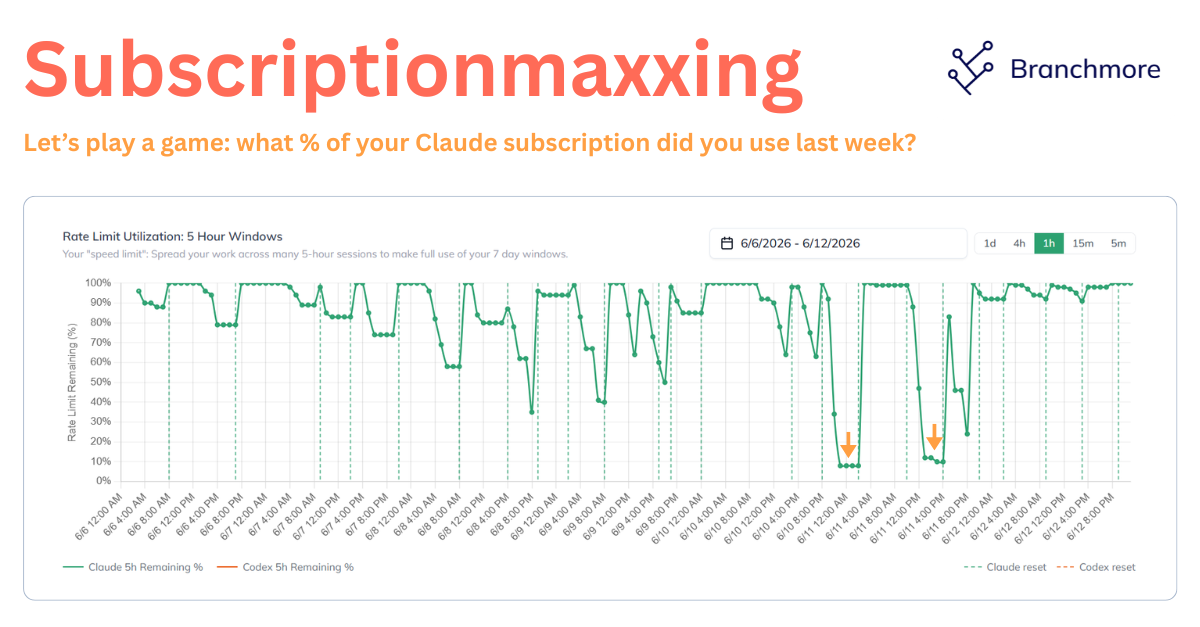
The idea of "subscriptionmaxxing" is basically: check your Codex and Claude weekly limits, and get as close to 100% as you can, every week. Tweak your configurations, add automations, and change how you work in order to achieve this goal. (Ignore the 5-hour limits because the weekly limits are the smaller bottleneck.)
I like to think of subscriptionmaxxing like a game. Just like tokenmaxxing challenged me to optimize my workflows to do more in a maximalist way, it gives me a dimension to optimize towards. But maximizing my subscriptions puts a spin on it, and focuses on optimizing for efficiency.
And, subscriptionmaxxing is both about saving money and about still finding ways to use up your tokens. It depends on how much budget you have, and the typical size of your workload.
Tips for maximize output with your AI subscriptions
First, let's check whether you're using what you pay for.
Try to get close to 100%, but you don't have to be perfect. I try to build a habit of opening my "Usage" view daily in Claude and GPT/Codex. I try to get to > 70% of my weekly limits, as many weeks as I can. You'll hit a lot of 5-hour limits, so it's helpful to spread out your work across the day and week.
You can increase the number of 5-hour windows you get per workday. The 5-hour window starts when you send your first message after an idle period. So a lot of folks have scheduled a cron job that sends a trigger message a few hours before their workday.
Check whether you can downgrade your subscription. It's easier and cheaper to maximize your subscription if you're using a smaller subscription. If you're using a small percentage of your subscription (< 30%), it's a quick thing to downgrade it and see if you can live with the smaller threshold.
Automation and long-running agents are great ways to make the most of your subscription. You can hook up your Claude/Codex subscriptions to your inbox, your notes, your personal finances, your news reader, etc. (Do it safely, you don't want it deleting all your data if it hallucinates.) Set up a daily/weekly cron job to perform a chore for you. You can do it with commands like OpenAI's /goal, Claude's /loop, or use one of the general-purpose agents like Openclaw or Hermes.
Tips for tokenminimizing for agentic coding
After you've made sure you've right-sized your AI subscription to your workload, let's try to squeeze more juice out of it.
Decrease the size of your tools and context. the number of MCP servers / plugins you have, and reduce the size of your root AGENTS.md files, because the full list of tool instructions / context consumes a large amount of tokens on each conversation start.
You can also specify custom CLI flags to reduce the "heaviness" of your harness. You can specify a lighter weight System Prompt with --system-prompt in Claude (but this doesn't exist for Codex). For a reduced toolset, you can use something like --tools "Read,Grep,Glob" in Claude, and --sandbox read-only in Codex to achieve something like a Readonly mode.
Default to mid-tier models that burn fewer tokens. Don't default to the premium Sol/Astra/Opus/Fable; use mid-tier models like Sonnet/Terra/Composer. You can adopt planning workflows where the "smarter" model does the designing/planning up front, and the bulk of the implementation is done by the mid-tier models, which are plenty good.
Can you make your conversations lighter? It's useful to investigate your most expensive sessions to learn why they're token-inefficient, and what you can do about it.
You should also set up token tracking and session tracking. This gives you a data-driven understanding of what your agents on doing. On that note, I should mention that I built Branchmore, a personal vibe-coding analytics app to help engineers track tokens and record their sessions. In particular, we help you track your historical subscription usage. And we built reports to help you identify where your token burn is excessive.
A quick aside: subscription vs API prices
OpenAI and Anthropic have two product lines where you can consume their models: via monthly subscriptions or their API platforms. A large portion of engineers are using their monthly subscriptions, which is much cheaper per token than their API platforms.
Subscriptionmaxxing, as a game, applies to those who are paying for monthly subscriptions. At the moment, Individual and Team plans in Codex and Claude offer "Premium" seats for "higher token capacity for each month." These monthly subscriptions allot you a certain number of tokens per month, and it's a "use it or lose it" situation.
This "game" doesn't directly apply to pay-as-you-go API prices. You don't have a monthly grant of tokens. While some of subscriptionmaxxing doesn't apply here, I think the "token-reducing" parts are particularly important for those paying API prices, since it's much more expensive per token.